



by Kate Shunney
Plant and bug experts in Maryland and West Virginia are on alert about a new pest that is damaging boxwoods as they feed on the shrubbery and infest areas around them.
The Maryland Department of Agriculture and USDA Animal and Plant Health Inspection Service (USDA APHIS) have confirmed the presence of box tree moth (Cydalima perspectalis) in a state park in Washington County as of late July. That was the first detection of this destructive pest in Maryland.
In West Virginia, the moth has been confirmed in neighboring Morgan County and in Berkeley County as well.
The pest is native to East Asia and was first detected in New York in 2021.
Other states have now seen the moth, including Delaware, Massachusetts, Michigan, Ohio, Pennsylvania and Virginia.
Pest experts say that adult moths are strong fliers and can move several miles.
The box tree moth caterpillars are green with black, yellow and white stripes, somewhere between .25 and 1.5 inches long. Adult moths will be white with brown margins on their wings, roughly 1.5 inches across. 
Boxwood shrubs are the only plant that the box tree moth seems to attack, said Extension experts.
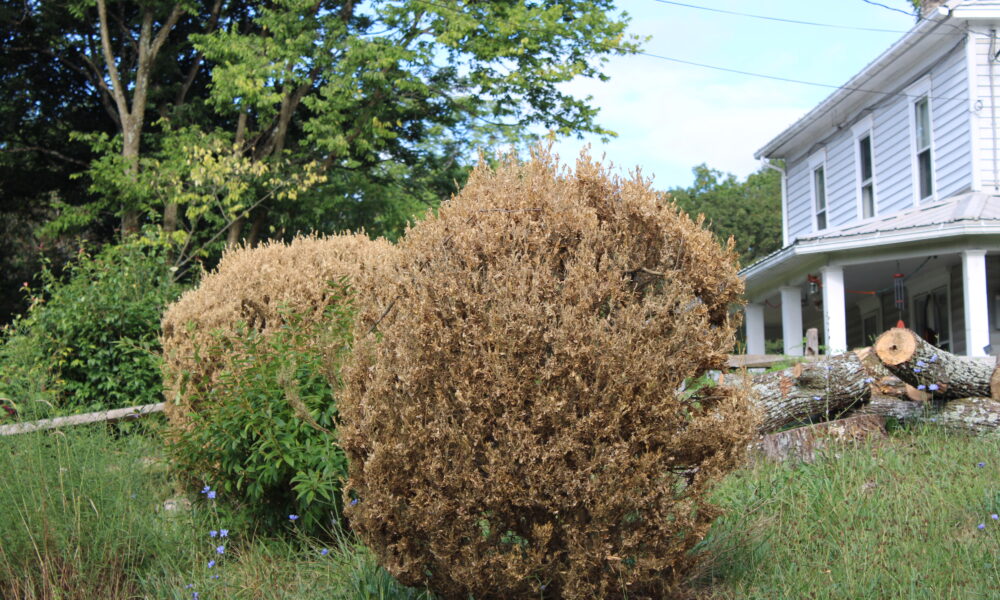
“Young larvae feed on the underside of the leaves, which gives them a ‘peeled’ appearance. Older caterpillars will consume entire leaves, except for the midrib. Caterpillars also create webbing between leaves with their silk. Infested plants will have patchy defoliation with webbing in light infestation and greater defoliation in heavy infestations,” a pest alert from the WVU Extension Service says.
“Adult female box tree moths lay their eggs… in a gelatinous mass on the underside of boxwood leaves. Box tree moths overwinter as larvae. Once temperatures rise, overwintering larvae emerge and typically begin feeding in March, continuing until they pupate in late April to early May,” says the U.S. Department of Agriculture. 
As they grow, the pest spins silken webs to hold leaves together to create a feeding area. They tend to feed on leaves in the lower portion of host plants but live in the upper portion of the boxwood.
Small infestations of the worm or moth on boxwoods can be treated by pruning the plant and destroying the affected branches.
Pesticides that contain Bacillus thuringiensis (BT) as an active ingredient can be highly effective against the box tree moth and lepidopteran species of pests.
“Another biopesticide that has shown high efficacy against caterpillars is Spinosad. Horticultural oils, insecticidal soaps, and chlorantraniliprole are reduced-risk insecticides that also should be effective on caterpillars. Last, there are several broad-spectrum insecticides, such as pyrethroids, labeled for control of other caterpillars on ornamentals that should also provide control. However, these products should be avoided because they are more toxic to beneficial insects and can cause outbreaks of secondary pests,” say specialists.
Large infestations of the caterpillar and moth can decimate boxwoods in an area. Damaged shrubs should be removed and destroyed to minimize any spread of pests. 
Residents who have caterpillar of moth damage are encouraged to contact the Maryland Plant Protection and Weed Management program at [email protected] and attach a photo in your email.