

by Geoff Fox
& Kate Shunney
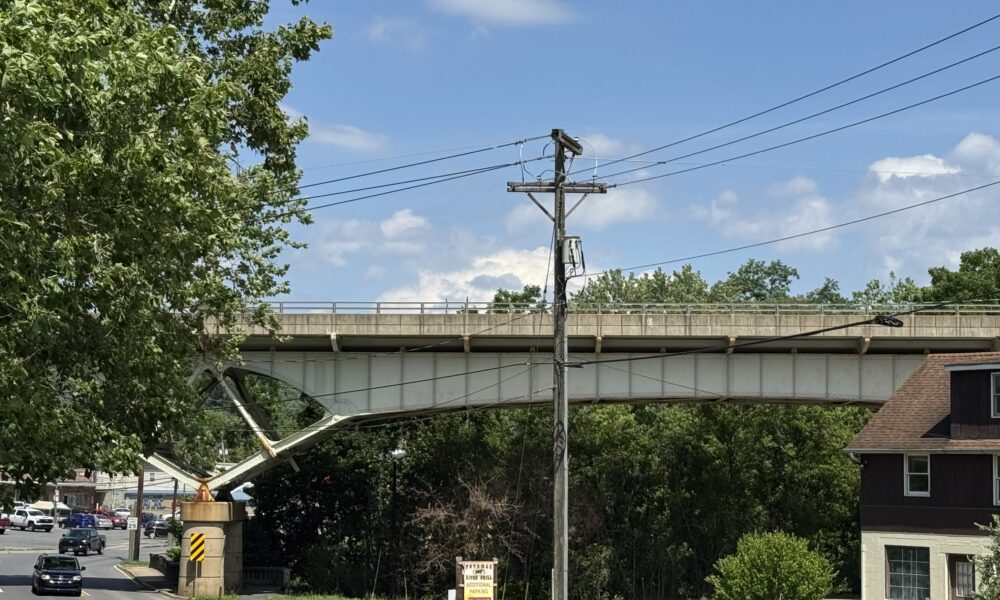
Hancock town officials last week confirmed that the Maryland Department of Transportation is now ready to prepare a plan to rehabilitate or replace the 90-year-old bridges that carry U.S. 522 over Hancock, regional trails, the Potomac River and CSX railways.
The results of a plan won’t be known until at least 2029, but the Maryland Department of Transportation (MDOT) is asking for $1.2 million from the federal Bridge Investment Program to prepare a Planning and Environmental Linkages (PEL) study of the two bridges.
“Built in the 1930s, the US 522 bridges will soon exceed their useful life,” MDOT officials wrote in their 29-page project document seeking federal planning dollars.
Draft MDOT US522 Connectivity and Freight Plan June 2026

Hancock bridge plan
Maryland and West Virginia have each pledged $150,000 toward the study, with an additional $100,000 each to cover cost overruns or budget adjustments as the planning process moves along, says the document.
Right now, hearings are being held to allocate funding for the study to determine what to do with the U.S. 522 bridge, Hancock Town Manager Mike Faith told Hancock council members and the public last week. Town officials approved a letter of support for the bridge study with the signatures of the mayor and council people.
The results of the study itself won’t be available until well into 2029, according to a timeline included in the project proposal. Assuming that funding is granted in late 2026, analysis of the bridge condition, traffic operations and other factors would begin in 2027. The development of “conceptual alternatives” is slated for mid-2029, with a final report to be prepared in late 2029 and early 2030.
Town Manager Mike Faith said a person was sent to Hancock to take pictures of the bridge, not aware there are two spans of the bridge – one over the Potomac River, C&O Canal, and Western Maryland Rail Trail, and another over Main Street and Limestone Road.
Faith said he told them about pieces of concrete falling onto Limestone Road and supplied photos of the concrete.
Faith said Hancock is heavily mentioned in the report and Hancock is included. There is a mention of a pedestrian bridge in the report as well, he added.
“I think we’ll get the things we want as long as we stay active and participate in the process,” he said.
In the grant application for the $1.2 million in planning funds, Maryland transportation officials acknowledge the importance of engaging local residents, businesses and governments in the planning process when it comes to developing options for a future Hancock bridge. Read the application document here:
Small glimpses into possible modifications are placed throughout the application, including mentions of widening the bridge to include shoulders and additional lane space, room for “intermodal” transportation, exits and entrances that specifically serve Hancock’s trail users, bridge elevations that bring visitors more closely into Hancock rather than just over it, and the possibility of changing the “geometry” of the bridge to improve driver visibility and access.
Movement of trucks and goods throughout the region is a key element of the grant application.

photo by Geoff Fox
Planning would support “The US 522 Bridge Connectivity and Freight Mobility Plan,” according to MDOT, which acknowledges that U.S. 522 is a “critical regional mobility link and cross-state connection between Maryland, West Virginia and Pennsylvania.”
In seeking the planning dollars, MDOT officials state plainly that the bridges carrying U.S. 522 are critical to commercial truck traffic and to residents, are at the end of their lifespan and require action.
“These bridges’ potential failure is a regional concern and a full replacement cost will likely exceed $250 million. Both MDOT and WVDOT consider rehabilitation of these bridges a critical priority requiring thoughtful redesign to address safety, accessibility and reliability concerns,” the document says.
Two bridges, one roadway
Under consideration is the structure most locals know as the Hancock Bridge. Opened in 1939, it is almost half a mile long (2,500 feet), is 27 feet wide and is rated in Poor condition by MDOT, which maintains the structure under a cost-sharing agreement with West Virginia. It crosses above the C&O Canal, Potomac River and CSX railroad on the West Virginia shore. This is cataloged as Bridge No. 210043001. It has an average daily traffic of 10,550 vehicles.
The shorter, smaller bridge in Hancock also carries U.S. 522 over Little Tonoloway Creek, Maryland 144, Hancock’s Main Street and Limestone Road. It’s 586 feet long and was built in 1937. This is Bridge No. 210124001. It has an average daily traffic of 10,911 vehicles.
Regional importance
“These bridges must support regional commerce while remaining sensitive to the rural context and scale of Hancock,” project officials note.
The grant application has several mentions of the regional importance of the bridges and U.S. 522 as a key connector of multiple interstate transportation routes, noting that anytime Hancock bridges have been closed, vehicular traffic and trucks are forced to take detours more than 30 miles out of the way.
“US 522 is also an alternate route for I-70’s role on the Appalachian Development Highway System (ADHS) and the Strategic Defense Network,” the document says.
Interstate highways were designed, in part, to serve the needs of the U.S. military in national defense, providing reliable ways to move military equipment by land.
Hancock’s bridges are also essential for public safety access, and U.S. 522 is an evacuation route in cases of disaster or national emergency. Not only that, but the bridges keep open access to rural hospitals like War Memorial Hospital in Berkeley Springs for area residents.
The new U.S. 522 bypass and hospital connector road are mentioned as “alignments” for an upgraded Hancock Bridge.
If funding is granted to MDOT’s State Highway Administration, the Planning and Environmental Linkages study of the two bridges will include:
–A purpose and needs statement
–Bridge concepts
–A crash analysis and traffic projection
–Public outreach efforts & feedback on concepts
–Coordination with the Town of Hancock
–Listing of potential investment that would improve land use, supply chains and economic benefits
–Evaluation of environmental impact areas.
End of life for bridges
Users of the bridges see the ongoing repairs being done over various parts of the structure – from the decking to the undersection. Drivers have observed shifting at deck joints in recent years, making the bridge surface uneven. Troubles extend to other parts of the bridges, including truss spans, corrosion, loss of decking and more. The multitude of areas needing upgrades have pushed highway officials to seek a bigger solution.
“Despite the US 522 Bridge being maintained to the highest stands possible, the end of its useful life is approaching,” said MDOT officials.
“MDOT has remained vigilant of ongoing maintenance requirements to ensure the US 522 Bridge stays in a state of good repair, but costs continue to escalate as necessary repairs and preservation work are required to maintain the bridge in this condition,” they note.
The lack of a shoulder on the bridge makes snow removal more difficult, hampers the option to move disabled vehicles out of travel lanes or to allow emergency vehicles to pass when traffic is stopped. Hancock and Berkeley Springs officials have also voiced support for adding a bike lane on the bridge to connect regional trailways. Highway officials envision a wider bridge structure with greater weight load ratings.
Modern technology like automatic traffic counters, pavement sensors, solar lighting and live weather cameras are also mentioned as possible upgrades to a future Hancock bridge system.
If grants pay for the Planning and Environmental Linkages study, Maryland and West Virginia can then pursue funding for the construction phases of the chosen rehabilitation concept.

File photo
“The PEL phase of the project will allow project stakeholders to further refine the needs of the capital construction project for the US 522 Bridge, and initiate the early discovery and financial planning necessary to support efficient project delivery,” the grant application says. “MDOT is confident that after confirming the preferred alternative identified in the PEL Study, the agency will start construction within two years of the PEL study’s completion.”