


by Geoff Fox
The appearance of buildings in town and the future of two buildings given demolition orders were raised once again during the October Hancock town meeting.
The conversation began when Debbie Murphy sat down at the table for citizen’s comments.
Murphy started by telling town officials why she moved to Hancock in the late 1970s and the organizations she’s been involved with over that time.
Since moving to Hancock, Murphy said the appearance of the town has changed drastically.
“I never expected that we could maintain a Main Street that looked like the 60s and the 70s, no small town can,” she said. “But it seems unfair to the existing businesses that our Main Street now has abandoned buildings that are in despicable condition.”
She added comments were heard about people stopping in the town, including former Governor Martin O’Malley, and enjoying their time in Hancock.
“You don’t hear that anymore,” she said.
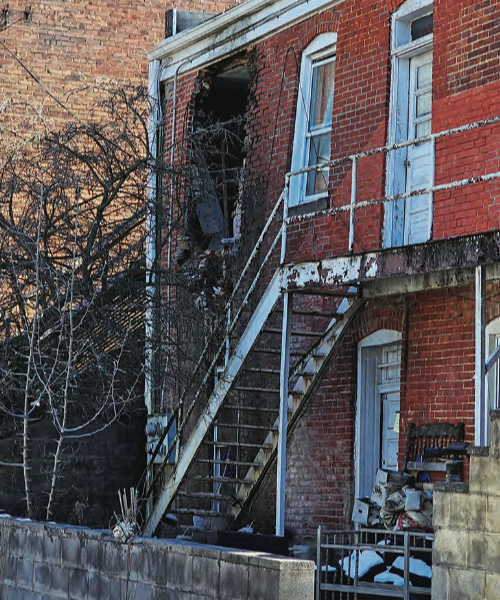
Murphy pointed out the east end of town has neglected houses with Main Street having a couple dilapidated buildings owned by the same person.
Even coming off the US 522 bridge, there’s a house on High Street in disrepair, owned by the same person, and when coming down Virginia Avenue to Main Street, there’s a house where the porch has collapsed.
Murphy also alluded to two more houses on High Street near Loaves and Fishes are also in the same disrepair.
“It’s time that these housing issues are resolved,” she said.

A county decision earlier this year was issued for the building at 144 West Main Street, but the rest remain on the hands of the town officials.
Murphy said she is asking the mayor and council to make the issue a priority.
“It’s already October and nothing has been done all year,” she said.
Murphy also asked town officials for a list of which councilmembers are on which committees so residents can take their issues to them instead of only to Mayor Roland Lanehart, Jr. or Town Manager Mike Faith.
“I’m asking, let’s get together and work to make Hancock look better,” Murphy said before leaving the table.
Town attorney addresses issue
Later in the meeting, the town’s attorney gave details about what efforts are being taken to deal with the buildings.
Town Attorney Ed Kuczynski had represented the Town of Hancock for 30 years before an eight-year hiatus, and coming back a couple years ago.
Before the hiatus, Kuczynski said the town had been discussing the blighted buildings and when he came back, they were still discussing them.
“That is a common theme in most small towns I represent,” he said. He added there are a few towns where there are people who can afford to fix up buildings.
In his observation of Hancock, Kuczynski said the problem that exists with the decaying and dilapidated buildings wasn’t something that happened overnight. It’s been an ongoing struggle.
Kuczynski said there are economic factors that are a part of it and whatever affluence was here have disappeared, along with the closures of manufacturing plants Fleetwood and London Fog.
He did note the cannabis industry has helped, but hasn’t replaced the dollars left by those companies that have left.
Kuczynski added the current town officials have been trying to address the issues of dilapidated buildings.
He also noted how the Weavers building has been sold and is now being renovated in hopes of opening once again with a restaurant.
The two buildings that have gotten a lot of attention are the building at 144 West Main Street and the house at 110 West High Street.
Kuczynski said both buildings had been under evaluation, review, and inspection by the county.
In having hearings on the two properties, the county found they were in need of repair.
However, Kuczynski said the county did not provide any assistance in what needed to be done after that. The Town of Hancock would undertake such remedial action and in any costs would become a lien, or owed debt, against the property.
“That’s great, in theory,” Kuczynski said, “if the cost of demolition, cost of condemnation, litigation all stays under the value of the lot.”
The problem, he said, is when the dilapidated property in Hancock is torn down at a cost of $30,000-$40,000. You’re left with a $10,000 lot with a $40,000 lien, he said.
“Good luck selling it,” he said.
That’s a practical problem that someone has to overcome because Hancock is not an affluent community.
Kuczynski said when looking at an excess of $20 million on a wastewater system upgrade, the question becomes where does the town find the $1 million or so to address the properties as looking dilapidated and falling down?
The two properties getting the most attention were deemed to be in violation of codes and are to be demolished.
Kuczynski said he and town officials have talked many times, but the difficulty facing the town is a property owners who doesn’t do anything with not just the one property, but others they own.
The property on High Street has since been sold and the new owner started working on it. That work has stalled due to permit issues, he said.
Kuczynski said the demolition of 144 West Main Street could cost $200,000. If it’s a high enough priority of the citizens, then the town should spend that.
But if the town were to take every building needing demolished, and the town fronts that money, Kuczynski said the chances of that money coming back to the town is slim to none.
He said at the policy level, there’s a major financial decision that has to be made because whatever monies may have been available at the state, aren’t going to be available now.
“All we can do is try to nudge and push,” Kuczynski said.
He also noted the town could go through code enforcement by charging through municipal infractions.
If the town were to issue tickets, each day would be a continuing violation, but there could be court costs because of prosecution.
Kuczynski said there are some people to whom it is nothing to go to district court and get hit with a $500 fine one month, come back a couple months later for a $1,000 fine, and so on.
Kuczynski said he’s represented property owners who have done that and dragged the process out for years.
“I’m only pointing that out because it is a frustration that is there for anybody who is trying to deal with this,” he said.
In working with big property owners, Kuczynski said they tend to disregard notices until they get served with something, then it becomes inconvenient because they have to take time out of their busy day to go to court.
Sinclair Hamilton asked Kuczynski if the nudging was already in effect and the owners are “playing” the town and citations should be issued.
Kuczynski said he agreed with Hamilton, but time passes and the county found the buildings needed to be demolished.
Councilman asks for action
Councilman Richard Strong got into the argument by asking if the town was finally going to do something about the properties instead of just talking about them.
“If I would have gotten off my ass this month it would have been done before I came here today, but I just didn’t get to it,” Kuczynski said.
“That’s obvious because you’re talking about it now,” Strong retorted.
Strong added the situation is getting old for him with Kuczynski saying the letters were going out.
Kuczynski said he and Faith had been talking about what to do about the properties and rather than issue citations, the letters were to go out.
“I just didn’t get the letters out,” he said.
Kuczynski said it would cost money and town officials would have to decide how much they want to spend and they can bust his chops over taking so long.
Strong said he didn’t want to bust his chops, just that people are tired of talking about it.
Strong said his thing is kids walking by and school buses driving by, what if one of the buildings falls on the kids or buses after talking about the buildings for months and nothing’s been done.
Kuczynski said there are other properties, so the other option is the town hiring a full-time code enforcement officer who could issue citations, notices, and doing inspections and then aggressively pursuing remediation.
Lanehart said the council could look at hiring the code enforcement officer. He added it shouldn’t be someone from Hancock as they wouldn’t know anyone.
If the town moves to the level of demolition, that brings in condemnation which could lead to litigation for 12 to 18 months.
If the town were to win the case, they’d own the building and would have to spend the money to demolish it.
That’s the way the law is set up – the town condemns the building, they own the building, they demolish the building.
“You could order the owner to demolish, but if they’re not going to spend a couple of bucks to board it up, what makes you think they’re going to spend $200,000 to demolish it?” Kuczynski said.
Strong added you could say that about a lot of buildings along Main Street.
“It’s just a shame that our town has turned into a, excuse my language everybody, a shit hole,” he said.
Sid Campos, owner of the 1887 River Run Bed & Breakfast, also spoke up during the meeting.
Campos said it sounded like it was just a waiting game until everything just fell apart.
“For the past 30 minutes, basically that’s what I understood was just like we wait, we do nothing, we don’t do any citations, we just keep issuing reminders — ‘hey guys take care of your properties’,” Campos said.
“You didn’t listen to what I just said,” Kuczynski snapped.
Kuczynski said the town is about ready to issue citations but they can’t just pound people into submission.
He said as soon as they start doing that, they’d have to do that to everyone or they get hit with lawsuits saying they’re selectively enforcing the codes.
“I completely understood what you said and I know there’s a process,” Campos.
Campos said he apologized if Kuczynski took it the wrong way, which Kuczynski said he didn’t.
“I head what you said,” he said.
Campos said to him it translated there wasn’t much the town could do, it would cost money and the town doesn’t have the money, and just play the waiting game.
Kuczynski started to speak over Campos and how the members of the town council, come budget time, could raise taxes for the demolition and how the actual responsibility falls on the property owner, not the town.
“This town believes in private enterprise, alright, not using the government to do everything for them. That’s been their approach,” Kuczynski said.
“I understand. I just wish I could hear more solutions instead of like is this a waiting game,” Campos said.
Kuczynski pointed out how Hamilton had offered to look into situations and report back and how Greenwill is in the business of looking for solutions as well.
To deal with all the properties in the picture, Kuczynski estimated it would cost in the millions of dollars to proceed with cleanup and demolition and legal proceedings.
Lanehart ended the discussion by gaveling the subject and moving on to the next agenda item.
On Monday, Town Manager Mike Faith said final warning letters went out to the owners of 144 West Main Street and 110 West High Street about the condition of their properties. The notice is the last step before fines start, said Faith.