



News

Amid rain, officials still watching drought & promoting conservation steps

by Kate Shunney

The Interstate Commission on the Potomac River Basin watches the water supply of the nation’s

capital closely, and in

even greater detail the last two years as a persistent drought hangs on in Maryland, West Virginia and parts of Virginia and Pennsylvania.

Conditions in the areas that empty into the Potomac River basin affect how much water is available for drinking, agriculture, recreation and even fire suppression.

Late last week, the

Commission reported

that a Drought Watch

has been declared for the metropolitan Washington region.

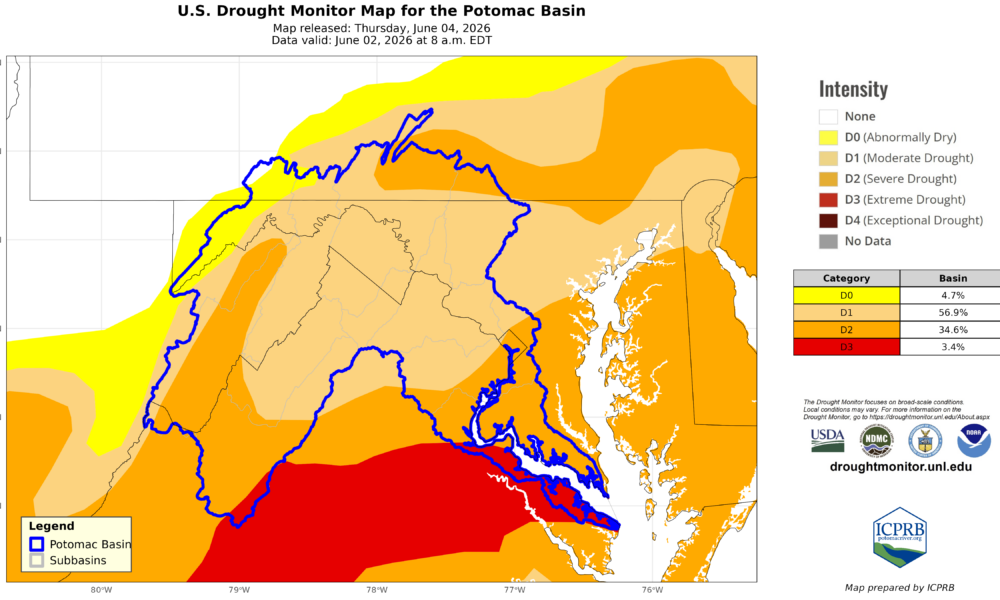
Caption: The U.S. Drought Monitor shows areas around the Potomac River Basin affected by a shortage of precipitation.

Authorities in the area, less than 100 miles away, are asking for voluntary water conservation among residents and businesses in the region, said Commission reports.

There are currently no mandatory water use restrictions in the metropolitan Washington region. The region hasn’t instituted mandatory water use restrictions since 1999, when Maryland issued a statewide declaration.

If conditions worsen, the next stage in the regional drought response plan is a Drought Warning, in which authorities will call for voluntary water use restrictions, said Commission officials.

“According to the U.S. Drought Monitor Map, 40 percent of the Potomac watershed is experiencing severe drought conditions or worse. When declaring a drought, agencies consider several indicators, including precipitation, groundwater levels, streamflow, and reservoir levels,” the Commission said.

“Recent rains brought temporary relief from the area’s long dry spell that dropped the flow in the Potomac to 130-year lows,” said Michael Nardolilli, Interstate Commission on the Potomac River Basin Executive Director. “Since then, however, the rains have stopped and we have once again entered a dry pattern.”

Rain in the region is 17 inches below average for the past two years, as reported by NOAA’s Regional Climate Center.

The U.S. Drought Monitor Map released on June 4 showed the area in Extreme Drought conditions was reduced to 3.4%, a small improvement over the prior week’s 8.5%. The majority of the watershed remains in Moderate or Severe Drought conditions.

River levels have fallen into the “normal” range but are expected to continue to fall.

Rain in the watershed is 7 inches below normal for the last calendar year. Minimal rain is expected over the next week.

Use summer caution

Despite the promise of some improvement with sporadic rainfall, river experts say water conservation is a good practice anytime, especially in the warmer months. Conservation will protect private wells, shared aquifers and public water supplies.

“As we go into the traditionally dry months of summer and fall, residents are urged to use water wisely,” says Nardolilli, providing examples for ways to reduce water use:

—Prioritize your outdoor watering. Only water newly planted trees, shrubs, and lawns. A slow drip (versus a heavy pour) will allow the water to reach the root system and not run off the soil.

—Check faucets and toilets for leaks.

—Take short showers instead of baths.

—Run the dishwasher and laundry only when full.